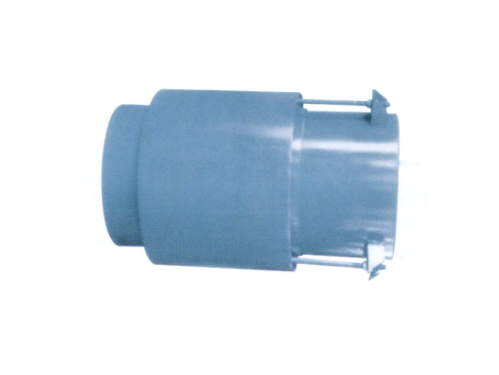
Unconstrained expansion joint
Product Introduction
1. Product Definition and Core Features
Unconstrained expansion joint (also called unconstrained corrugated compensator) is a key device for pipeline axial displacement compensation. Its biggest feature is that it breaks through the strict limitation of traditional axial expansion joint on the spacing of guide brackets (such as L₁ ≤4D, L₂ ≤14D, etc.). Through the unique self-guided structure and bending resistance design, the layout of pipeline support can be simplified, and the installation flexibility is strong. At the same time, it has columnar stability and anti-instability ability, which is suitable for complex working conditions.
2. Structure and composition
Core components:
Bellows: Single/multilayer U-shaped austenitic stainless steel (such as 1Cr18Ni9Ti) is adopted, which is responsible for absorbing axial displacement.
guide tube: Built in the bellows to guide the flow of the medium and reduce the scouring.
Shield: External protective bellows to enhance mechanical strength, some models include guide rod and ear plate support structure.
Connection mode: Flange or connector (optional carbon steel, stainless steel material).
3. Technical parameters and specifications
Nominal diameter (DN): 32-1500 mm.
Pressure range: 0.25-2.5 MPa.
Compensation amount: Up to 200mm (such as CXJX400-1.6/200-F model).
Temperature adaptability: The conventional material has temperature resistance ≤350 ℃, and the special design can reach 500 ℃.
4. Application Scenario
industry: Chemical industry, electric power, metallurgy, thermal pipe network, ship, etc.
Laying method:
For overhead or trench pipelines, guide brackets are required (3 in each fixed bracket spacing).
Inspection wells or dark rooms should be set up during direct burial laying to avoid the accumulation of sundries.
5. Installation and Maintenance Points
Installation direction: The guide tube should be consistent with the flow direction of the medium to avoid reverse installation affecting the performance.
Pressure test requirements: The hydraulic test pressure shall not exceed 1.5 times the nominal pressure, and shall be carried out after the fixed bracket is installed.
maintenance: Regularly check the status of the guide bracket and the bellows protective cover, and pay attention to waterproofing and anticorrosion for direct burial.
6. Summary of Advantages
Simplified design: There is no need to strictly spacing the guide brackets, which reduces the engineering cost.
High reliability: Strong anti-bending and anti-instability performance, avoiding the twisting problem of traditional expansion joint.
Strong adaptability: Support multi-directional displacement compensation, suitable for high temperature, corrosive medium environment.
Looking forward to working with you
If you have any questions about our products or services, please feel free to contact us